GENERAL DATA
UNIVERSITY CORDINATOR OF THE PhD PROGRAMME
Universitat de Lleida


Universitat de Lleida


President: Dr. Carlos Cantero-Martínez (carlos.cantero@udl.cat)
Secretary: M. Elena González Fandos (elena.gonzalez@unirioja.es)
List of the members:
Universitat de Lleida:
Universidad de La Rioja:
Universidad de Zaragoza:
Universidad Pública de Navarra:
This doctoral programme is structured around the three main classic agri-food areas that range from primary production to processing: Plant Production, Animal Production and Food Science and Technology, under a perspective of sustainable intensification and in which it is intended to promote inter or multidisciplinary activities. The lines of research indicated below are developed by eight research teams in which more than 90 doctors from the four universities of the Iberus Campus and four collaborating research institutions participate.
PV.1 Molecular, genetic and physiological bases of performance and quality
| Ariz Arnedo, Idoia | UPNA | |
| UPNA | cesarai@unavarra.es | |
| UNIZAR/EEAD-CSIC | becana@eead.csic.es | |
| UPNA | rmcanals@unavarra.es | |
| UNIZAR/EEAD-CSIC | acasas@eead.csic.es | |
|
Castillo Alonso, Ana M. |
UNIZAR/EEAD-CSIC | amcast@eead.csic.es |
| UNIZAR | pcatalan@unizar.es | |
| UNIZAR/CITA | acirujeda@aragon.es | |
| UNIZAR/EEAD-CSIC | bcontreras@eead.csic.es | |
|
Igartua Arregui, Ernesto |
UNIZAR/EEAD-CSIC | igartua@eead.csic.es |
| UdL | lluis.martin@udl.cat | |
| UPNA | carlos.miranda@unavarra.es | |
| UdL | marian.moralejo@udl.cat | |
| UdL | anamaria.pelacho@udl.cat | |
| UPNA | lramirez@unavarra.es | |
| UdL | ignacio.romagosa@udl.cat | |
| UPNA | gonzaga.santesteban@unavarra.es | |
| UdL | roxana.savin@udl.cat | |
| UdL | ||
| UNIZAR/EEAD-CSIC | valles@eead.csic.es |
PV.2 Soils, water and environment
| Alcasena Urdiroz, Fermín Jesús | UPNA | |
| UNIZAR/EEAD-CSIC | jorgeaf@eead.csic.es | |
| UdL | angela.bosch@udl.cat | |
| UdL | carlos.cantero@udl.cat | |
| UdL | encarna.companys@udl.cat | |
| UPNA | alberto.enrique@unavarra.es | |
| UdL | josep.galceran@udl.cat | |
| UdL | rosa.poch@udl.cat | |
| UdL | jaume.puy@udl.cat | |
| UdL | mariaconcepcion.ramos@udl.cat | |
| UdL | carlos.rey@udl.cat | |
| UdL | ||
| UNIZAR | mauson@unizar.es | |
| UPNA | inigo.virto@unavarra.es |
PV.3 Production and quality systems and management
PA.1 Nutrition and feeding
| UdL | javier.alvarez@udl.cat | |
| UdL | joaquim.balcells@udl.cat | |
| UNIZAR/CITA | mblanco@aragon.es | |
| UdL | gabriel.delafuente@udl.cat | |
| UNIZAR | mfonde@unizar.es | |
| UNIZAR/CITA | mjoy@cita-aragon.es |
PA.2 Production and quality systems and management
| UPNA | leo.alfonso@unavarra.es | |
| UPNA | aarana@unavarra.es | |
| ICVV-UR-CSIC-GR | monica.bueno@icvv.es | |
| UNIZAR | marimar@unizar.es | |
| UNIZAR/CITA | icasasus@cita-aragon.es | |
| UPNA | kizkitza.insausti@unavarra.es | |
| UNIZAR | levrino@unizar.es | |
| UPNA | jamendi@unavarra.es | |
| UNIZAR | olleta@unizar.es | |
| UNIZAR/CITA | asanz@aragon.es, albisanz@unizar.es | |
| UPNA | vsarries@unavarra.es | |
| UPNA | soret@unavarra.es | |
| UdL | daniel.villalba@udl.cat |
CTA.1 Product and Process Improvement, Optimization, and Development
| Arbizu Milagro, Julia | UR | |
| UPNA | inigo.arozarena@unavarra.es | |
| UPNA | mjberiain@unavarra.es | |
| UPNA | iosune.cantalejo@unavarra.es | |
| UdL | pedro.elez@udl.cat | |
| UNIZAR | fjavier@unizar.es | |
| UR | elena.gonzalez@unirioja.es | |
| UPNA | pi@unavarra.es | |
| UPNA | remedios.marin@unavarra.es | |
| UdL | olga.martin@udl.cat | |
| UdL | maria.motilva@udl.cat | |
| UdL | isabel.odriozola@udl.cat | |
| UdL | gemma.oms@udl.cat | |
| UNIZAR | pagan@unizar.es | |
| UR | consuelo.pizarro@unirioja.es | |
| UdL | mariapaz.romero@udl.cat | |
| UdL | robert.soliva@udl.cat | |
| UR | alberto.tascon@unirioja.es | |
| UPNA | debora.villano@unavarra.es |
CTA.2 Food Safety and Quality
| UNIZAR | filomena@unizar.es | |
| UNIZAR | herremar@unizar.es | |
| UNIZAR | sloran@unizar.es | |
| UdL | sonia.marin@udl.cat | |
| UNIZAR | cnerin@unizar.es | |
| UNIZAR/CITA | bpanea@aragon.es | |
| UdL | antonio.ramos@udl.cat | |
| UdL | vicente.sanchis@udl.cat |
CTA.3 Transformation and quality systems and management
| UdL/IRTA | gemma.echeverria@irta.cat | |
| UdL/IRTA | jordi.gine@irta.cat | |
| UdL/IRTA | Christian.Larrigaudiere@irta.cat | |
| UdL | marialuisa.lopez@udl.cat | |
| UR | idana.salazar@unirioja.es | |
| UR | pilar.vargas@unirioja.es |
The entry profile corresponds to graduates of an official Bachelor's Degree + university Master's Degree related to agri-food, life and nature technologies and sciences.
Master's degree studies recommended for the programme are considered to be specialisation studies that correspond to the following areas:
Students who have completed the aforementioned degrees are considered to have sufficient and necessary basic knowledge of disciplines related to biology, chemistry and technologies in the agri-food or biotechnological field to carry out the doctorate.
Given the thematic breadth of this Programme, the Academic Committee will assess the suitability of each applicant's profile to the specific line of research in which they express their interest.
The doctoral student must have knowledge of English equivalent to level B2 in accordance with the Common European Framework of Reference for Languages (CEFR), both for reading and understanding the bibliography and for participating in some of the training activities and for the writing of scientific documents appropriate to the stage of training in which they are.
The admission of students to the Doctoral Programme presented will follow the principles of respect for fundamental rights and equality between men and women, as well as the principle of universal accessibility.
The doctoral students of the programme will be able to benefit from the support and monitoring systems offered to the University in which they are enrolled.
At the University of Lleida , doctoral students have, among other support services, the following:
Official Registration and Publications
Verification, monitoring and accreditation
|
Effective Date |
Evaluation |
Report |
|
31/10/2019 |
Verification (AQU) |
|
|
17/12/2019 |
Council of Universities |
The most relevant procedures related to the doctorate are summarized below, according to their temporal sequence.
If admitted, the student will be assigned a tutor and, where appropriate, will be informed of the complementary training to be taken.
The formalisation of enrolment in doctoral academic supervision will be compulsory during all the years until the deposit of your thesis.
In the following links you will find information on each university on deadlines, documentation to be provided, etc.:
University of Lleida Link to the WEB
University of La Rioja Link to WEB
University of Zaragoza Link to WEB
Public University of Navarra Link to WEB
AFTER ENROLMENT
In any case, the system allows the configuration of the Activities Document (online access) of each student, who is responsible for the incorporation of the activities that they carry out during their doctorate. This document must be regularly submitted by the tutor and the thesis supervisor and will be evaluated by the Academic Committee annually.
Before the end of the first year, the doctoral student will draw up a research plan, which must be endorsed by the tutor and the thesis supervisor. In subsequent years, a follow-up report of the research plan must be made, which will be endorsed again by the tutor and director.
The doctoral thesis is original research, developed under the direction of one or more doctors, within the framework of a line of research that is part of a Doctoral Programme.
In this program, the theses must be co-supervised by two researchers linked to two of the universities of Campus Iberus.
During the doctoral period, in addition to specific training on aspects directly linked to the thesis, doctoral students receive training in transversal aspects; The aim is to facilitate the acquisition of a set of knowledge, tools and skills that adequately prepare them for both research and a competitive and high-level labour market.
Each director/tutor will indicate to the student the training activities to be carried out during the completion of their doctoral thesis.
Access is the right that a person has to apply for admission to a university to carry out certain studies (in what concerns us, doctoral studies).
In order to access the doctorate, the requirements established by current Spanish legislation must be met. In general, candidates must hold a Bachelor's and Master's degree, or equivalent, with a total duration of 300 ECTS.
Students with a foreign degree issued by a country included in the European Higher Education Area (EHEA) may apply directly for admission. If the degree is issued by a country outside the EHEA, the application for access must be made with a non-approved foreign degree.
Doubts regarding the access requirements as well as the details of the procedure to apply for a foreign degree (outside the EHEA) can be consulted at the Doctoral School (ED) of the university where you wish to take the doctorate.
Admission implies the effective acceptance of a student into a given study and university. In this case, in the doctoral programme in Efficient Agri-Food Production and Quality Systems.
In the application process for admission it is essential to take into account both the academic aspects and the administrative procedures. In this link you will find information regarding ADMISSION to this program
Once the communication has been received that their application for admission has been accepted, the interested party must enrol in the Doctoral School where they have been admitted.
Doctoral students must renew their enrolment annually, on the dates indicated in the academic doctoral calendar of each university.
Through the links indicated you can access the academic calendars of the doctorates of the universities.
It is necessary for each doctoral student to be particularly attentive to the relevant dates (admission, enrolment, presentation of the research plan, etc.) at the university where they are going to study or are already studying this doctorate.
The academic committee of the programme will meet at least once a month to resolve procedural matters and ensure the correct monitoring of the monitoring processes of the doctoral students.
APPLICATION FOR ADMISSION
In order to apply for admission to the doctoral programme, two aspects of the procedure must be taken into account:
- Academic aspects. They are the responsibility of the Academic Committee of the programme. The admission requirements will be the same for all those interested in studying this joint doctoral programme and the merit scale indicated below in this section will be applied.
- Administrative procedures: The application for admission must be formally submitted to the selected university, and must comply with the provisions of the corresponding Doctoral School. (Administrative contact)
In general, students interested in studying the doctoral programme must provide the following documents:
- Duly completed online admission form
- Transcript
- Curriculum vitae
- Letter including an expression of interest reflecting the preferred line or lines of research as well as the motivation to carry out the doctorate. This document may indicate the name of a researcher as a possible thesis supervisor.
- Justified application, if applicable, for part-time admission.
- Request for adaptation of admission requirements when there are special needs derived from the disability.
- Legal justification of the degree that gives access to the doctorate (this only if it comes from a university other than the one where you are applying for admission)
- In the case of degrees that have not been recognised and/or obtained outside the EHEA, legalised and informative documentation with all the data about the degree presented, for evaluation by the Academic Committee.
The academic committee of the programme, in view of the documentation submitted, will determine whether or not the applicant must take complementary training. Finally, the academic committee:
- Admit the student to the program (without or with complementary training*)
- It will reject admission in a reasoned manner.
Once admission has been approved, the student will enrol within the period established annually in the academic calendar. At the time of admission, each student will be assigned a Tutor, who may be their Thesis Director or another PhD researcher of the doctoral program related to the research topic of the thesis.
NUMBER OF NEW ANNUAL PLACES
- University of Lleida: 3
- University of La Rioja: 2
- University of Zaragoza: 3
- Public University of Navarra:3
SELECTION OF CANDIDATES
1. The evaluation of the applications by the Academic Committee will be made according to the selection criteria indicated below.
2. Once the admission process has been completed, applicants will receive formal communication of the Academic Committee's decision. If admitted, the communication will include the assigned tutor as well as, where appropriate, the training complements assigned.*
Admission to the programme will not imply, in any case, any modification of the academic and, where appropriate, professional effects that correspond to the previous degree held by the interested party, nor its recognition for purposes other than that of studying doctoral studies.
SELECTION CRITERIA
In general, when the number of applications for admission that meet the established requirements is greater than the number of places offered, the Academic Committee will take into account the following general criteria: (The scores awarded refer to a scale of 100 points; a minimum of 60 points will be required in order to be admitted .)
1. The average grade of the academic record: up to 50 points. The grade may be weighted according to the degree of affinity of the degree that gives access to the doctoral programme.
a. Bachelor's degree (or equivalent): a maximum of 30 points will be awarded.
b. Master's level training: the average grade will be up to 20 points.
2. Letter of expression of interest: up to 25 points
The coherence and knowledge on the part of the doctoral student, according to their level of training, of the specific field in which they express their interest will be assessed.
3. Formal recognition of their academic record: up to 5 points
4. Have received a research initiation grant: up to 5 points
5. Additional experience in introductory research activities or professional experience related to the programme: up to 10 points
6. Accredited knowledge of languages of scientific interest: up to 5 points.
An interview may be held to clarify those aspects of the documentation provided in the application that are considered necessary.
__________
* The complementary training courses are subjects of the master's degrees of the universities of the Programme and can be both methodological and basic training. Their assignment will be made with the help of the tutor, taking into account the areas in which the doctoral student's work will be carried out.
Of the articles published or accepted, at least two must be published in journals that occupy relevant positions (quartile 1, 2 and 3) in the Science edition or the Social Science edition of the Journal Montmrern Reports. Likewise, journals that occupy these same quartiles in the Scimago Journal Rank according to the Suject Category or the journals contained in databases such as Science Citation Index (SCI), Social Science Gelin Index (SSCI), Arts & Humanities Gelin Index (A&HCI), Scopus or the Carhus plus lists (A or B) are considered.
A letter from the thesis supervisor must be submitted showing the situation of each of the articles (published or accepted) and the impact index of each of the articles that are part of the thesis.
As part of the training plan for the programme's doctoral students, a one- or two-day seminar is organised annually. The venue is chosen, on a rotating basis, among the four universities responsible for the doctoral programme in Efficient Production Systems and Agri-food Quality.
Renowned specialists participate in the seminar, and sessions are also scheduled in which young researchers have the opportunity to present their work.
All doctoral students in the programme must attend at least one of these seminars during their PhD. It is particularly recommended for first-year students.
The doctoral students of the programme are subsidised for travel from the headquarters of their universities of origin, accommodation and working meals.
|
II JORNADA DEL PROGRAMA DE DOCTORADO SISTEMAS EFICIENTES DE PRODUCCIÓN Y CALIDAD AGROALIMENTARIA 7/11/2023 Universidad Pública de Navarra
|
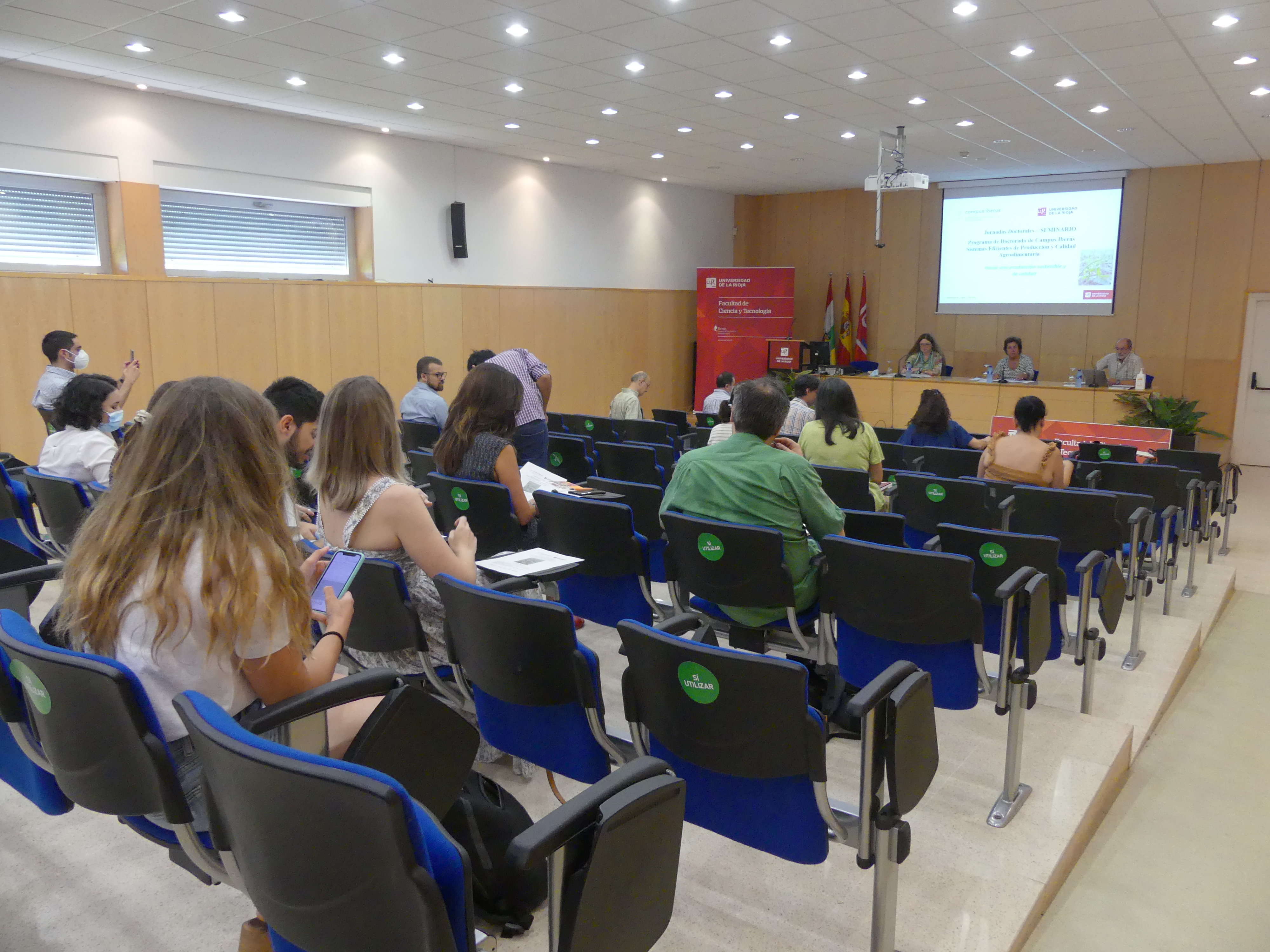 |
I JORNADA DEL PROGRAMA DE DOCTORADO 'Hacia una producción sostenible y de calidad' 12 de julio de 2022 - Universidad de La Rioja |
On this page you'll find information about Doctoral Theses completed or in progress in this Doctroral Programme
Completed and defendes Theses
| PhD | Theses title | Thesis supervision | University of the defense | Date of defense |
|
Diego Nicolas Bottegal Rosales
|
Effects of feeding lambs and pigs with a condensed tannin source (carob pulp) and α-tocopherol on performance, physiology, animal behaviour, and meat quality |
Javier Álvarez Rodríguez (UdL), María Ángeles Latorre Gorriz (UNIZAR) and Sandra Lobón Ascaso (CITA-UNIZAR) |
UdL
|
29/11/2024 |
| Alba Martínez Laorden | Caracterización y resistencia a antibióticos de bacterias de origen animal y cárnico: porcino y aves. Influencia del tratamiento con antibióticos |
Elena González Fandós (UR) and M. Jesús Cantalejo Díez (UPNA) |
UR | 22/11/2024 |
Tesis en curs
| PhD | Theses title (provisional) | Thesis supervision | University | |
|
Mohsen Ramezani |
|
Olga Martin Belloso (UdL), Irene Esparza (UNIZAR) and Laura Trujillo (UdL) |
UdL
|
|
| Celia Arráiz Fernández | Caracterización de bacterias resistentes a antibióticos y genes de resistencia en queso y carne fresca |
Elena González Fandós (UR) and M. Jesús Cantalejo Díez (UPNA) |
UR | |
| Alejandro Valera del Aguila |
Desarrollo de modelos para la estimación de la cosecha y producción de biomasa en olivar |
Alberto Tascón Vegas (UR) and Fco. Javier García Ramos (UNIZAR) | UR | |
| Isabel Cuadrado Galera |
Uso del agua ionizada como estrategia de control de oídio en vid |
Alberto Tascon Vegas (UR), Silvia Arzaruri Garin (UPNA) and Francisco José Castillo Ruiz (U. Córdoba) | UR | |
| Walter Andrés Bosich |
Evaluación del efecto del cambio climático en la calidad y fisiología del melocotón |
Gemma Echevarria (IRTA-UdL) and Celia M. Cantín (EEAD-UNIZAR) | UdL |
